
Hire a general contractor when your renovation involves more than one trade, a permit or structural work. Choose one who proves insurance and coverage, gives you a detailed written quote, and has a contract that spells out scope, payments, changes, permits and cleanup. At In-Trend Home Solutions, we run renovations, accessibility modifications and title insurance restoration across the Greater Toronto Area and Southwestern Ontario, and the checks below are the ones we would want any homeowner to make.
TL;DR
- A general contractor (GC) coordinates the trades, permits, schedule and site so you deal with one accountable party instead of five.
- Before you sign, ask for proof of liability insurance, workers’ compensation coverage and references, and get at least three detailed quotes.
- In Ontario, a renovation contract over $50 must be in writing, and the government recommends keeping the deposit to 10% of the total or less.
- Walk away from cash-only discounts, refusals to give references, requests for full payment up front and any plan that makes you pay subcontractors yourself.
- Ontario’s Construction Act has a 10% holdback rule that affects you as the owner, so settle it in the contract.
Table of Contents
- What a general contractor does, and when you need one
- Step 1: Verify who you are hiring
- Step 2: Questions to ask a general contractor
- Step 3: Compare quotes like for like
- Step 4: What the contract must say
- Red flags that should make you pause
- Permits are part of the job
- Prepare your side of the project
- Why a single accountable contractor pays off
- How In-Trend Home Solutions can help
- FAQ
- Sources
What a general contractor does, and when you need one
A general contractor takes responsibility for the whole job. That means pricing the work, hiring and scheduling the trades (framers, electricians, plumbers, tilers, painters), arranging inspections, ordering materials, keeping the site safe and clean, and answering to you when something goes wrong.
You need one when the project has several trades that must happen in sequence, when walls, floors or foundations are being altered, or when permits and inspections are involved. A basement conversion, an addition, a kitchen that moves plumbing and gas lines, or a barrier-free bathroom with a curbless shower all fit that description. A single-trade job, such as replacing a faucet, does not.
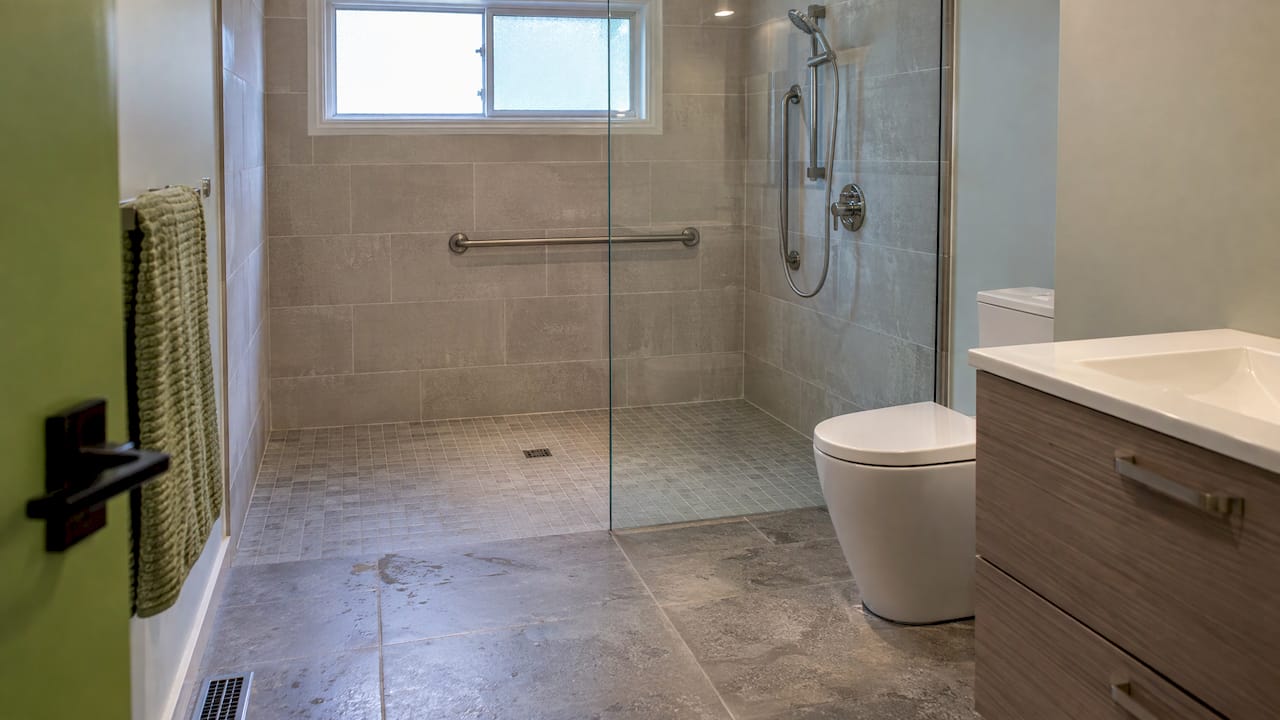
The real value is sequencing. If the plumber’s rough-in is late, the drywall crew sits idle and the schedule slips. A GC absorbs that problem. Without one, you absorb it, and Ontario’s regulator warns homeowners to pause if a builder wants them to manage trades or pay subcontractors directly (more on that below).
Step 1: Verify who you are hiring
Start with paperwork, not with the quote. Canadian consumer agencies agree on the core list. New Brunswick’s consumer commission tells homeowners to obtain proof of business liability insurance, workers’ compensation coverage, any trade licences required, a business or HST number, and receipts for every deposit and payment. Alberta’s government likewise says to verify WCB coverage and get an insurance certificate showing public liability and property damage cover for the workers on your job.
In Ontario, apply the same list:
- Liability insurance. Ask for the certificate, and check that the name on it matches the name on the quote and contract. It protects your home if a worker damages it.
- Workers’ compensation. Ask for a current WSIB clearance certificate where one applies. If an uninsured worker is hurt on your property, you do not want to find out then.
- A real business identity. A full address, a business number and an HST number. Quebec’s consumer office specifically advises checking a full address rather than accepting only a phone number.
- Licences for regulated trades. Electrical and gas work, for example, must be done by licensed people. Ask who is licensed and for what.
- Builder licensing where it applies. Ontario’s Home Construction Regulatory Authority (HCRA) says to pause and get independent legal advice if a builder will not provide licensing or Tarion evidence where applicable.
A note for readers outside Ontario: rules differ by province. Quebec, for instance, requires renovation contractors to hold an RBQ licence, and its registry lets you confirm the licence and the legal name. Alberta advises checking with your local government about which permits and inspections apply and at what stages. The rest of this guide is written for Ontario homeowners.
Step 2: Questions to ask a general contractor
CMHC’s guidance for homeowners gives a solid interview script. Its list covers how long the business has operated, its specialty and similar-project experience, whether it uses its own crew or subcontractors, what work they are licensed to do, how problems are handled, schedule and cleanup, insurance, permits, warranties, written contracts and references.
Turn that into questions you can ask in the first meeting:
- Have you completed projects like mine, and can I see them or speak to those owners?
- Who will be on site every day, and who is my single point of contact?
- Which parts of the job do your own crew do, and which go to subcontractors?
- Who applies for the permit, and who books the inspections?
- What happens if you find something unexpected behind the wall, such as rot, old wiring or a structural problem? How is that priced and approved?
- What is the start date, the finish date, and what happens if the schedule slips?
- How will you protect the rest of my home from dust, and how is the site cleaned daily?
- What warranty do you give on workmanship, in writing?
Listen for specifics. A good contractor answers the change-order question without hesitation, because it is the point where most renovation disputes start. If you are renovating for accessibility, add one more: has this contractor built barrier-free bathrooms, ramps or lifts before, and do they understand the clearances involved? Our page on why to hire an accessibility contractor explains what that specialist experience looks like.
Calling references properly
Do not just collect names. CMHC advises asking references whether the contractor communicated well, delivered quality work, finished on schedule and within budget, resolved problems, and would be hired again. The question about problems is the most revealing. Every project has some. What matters is how the contractor responded.
A refusal to provide references is itself a signal: New Brunswick’s commission lists it among the warning signs of a contractor to avoid.
Step 3: Compare quotes like for like
Quebec’s building regulator recommends requesting at least three quotes and comparing how well each contractor understands your needs, the detail of the quote, materials, schedule and start and end dates, cost, payment terms and guarantees. That is good practice anywhere in Canada.
The trick is making the quotes comparable. Give every contractor the same drawings or the same written scope, and the same list of finishes. Then lay the quotes side by side:
| What to compare | What a strong quote shows |
|---|---|
| Scope | Room-by-room description of the work, including demolition and disposal |
| Materials | Brand, model or grade, with allowances clearly labelled |
| Permits | Who applies, who pays, who books inspections |
| Trades | Which are done by the crew, which are subcontracted |
| Schedule | Start date, milestones, finish date |
| Payment | Deposit, progress payments tied to completed stages, final payment |
| Warranty | Length and what it covers, in writing |
| Cleanup | Daily site cleaning and final cleanup |
New Brunswick’s commission adds a point worth remembering: do not automatically choose the lowest bidder, because a low bid can cost more later. A gap between quotes usually means someone left something out: permits, protection of finished areas, a proper allowance for materials. Ask the cheapest contractor what is not included before you compare totals.
Step 4: What the contract must say
Ontario’s government states that renovation contracts worth more than $50 must be written, and that they should identify the parties, describe the work and materials, state warranties, total cost and taxes, the schedule, subcontractors, the payment schedule and who handles cleanup. HCRA adds that you should review dates, deposits, scope, insurance, changes, warranties and responsibility for permits and trades.
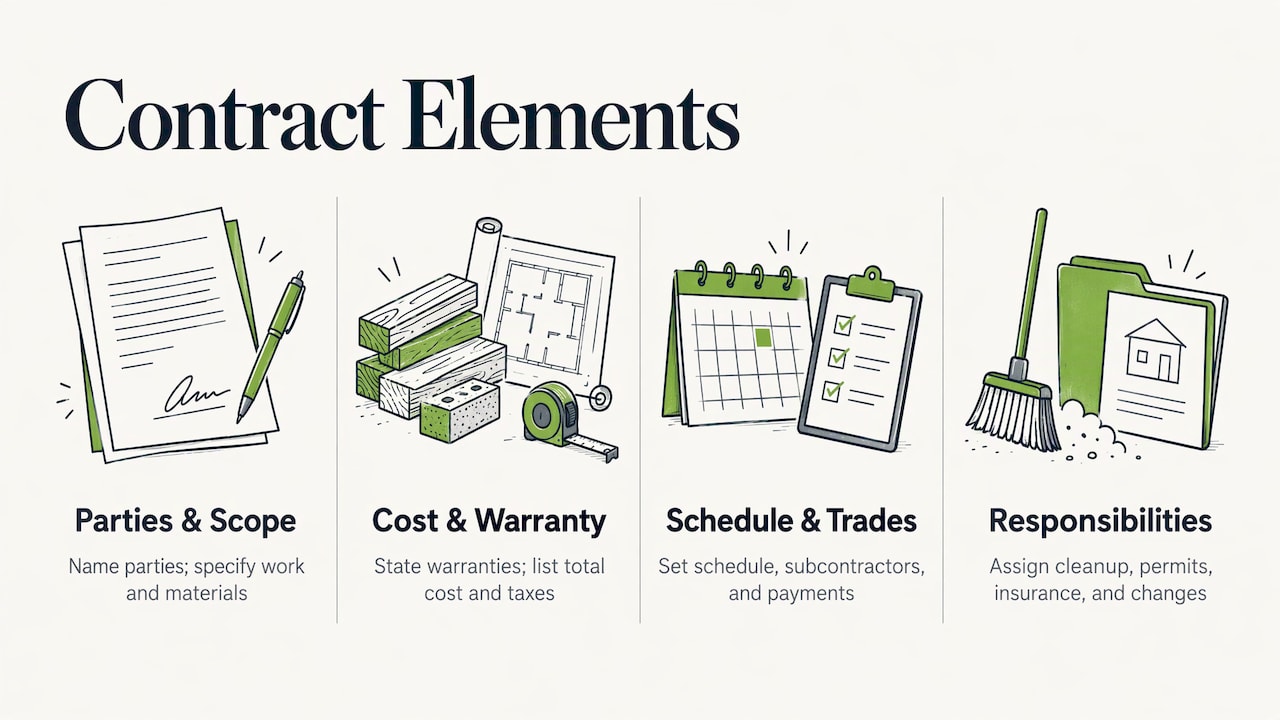
Alberta’s guidance is more detailed on a few points that apply equally well here: the contract should cover subcontracted work, permit and inspection responsibilities, code compliance, debris removal, cancellation rights and dispute resolution, and it should document approved changes. It also suggests filling blank spaces with “N/A”, initialling any changes, and considering a legal review, since a signed contract is legally binding.
Deposits and payment schedule
Ontario government guidance recommends that deposits should not exceed 10% of the total project cost, with the deposit and payment schedule stated in the contract. Quebec’s RBQ goes further, advising the smallest deposit possible and holding back final payment until the work is satisfactory. Tie each progress payment to a finished stage, such as framing complete and inspected, not to a calendar date.
The 10% holdback
This is the part most homeowners miss. Ontario’s Construction Act requires a payer to retain a 10% holdback on services or materials supplied under a contract where a lien may arise, until the liens against the holdback expire or are otherwise dealt with. If you ignore it, the Act also means an owner can be personally liable for holdbacks they were required to retain if valid liens attach to the owner’s interest. Ask your contractor how holdback will be handled on your project and have it written into the payment terms. For a large job, a lawyer can confirm the mechanics before you sign.
Changes
Put one rule in writing: no extra work without a signed change order stating the added cost and any added days. Most budget overruns are verbal agreements remembered differently by each side.
Red flags that should make you pause
- A discount for cash. New Brunswick’s commission warns that cash deals can leave you exposed to uninsured work, missing permits, poor workmanship and weak legal recourse.
- Full payment before completion, or no written contract at all, which the same commission lists as warning signs.
- No proof of licensing, insurance or coverage when you ask.
- Unclear rights to change the price. HCRA says to pause and seek independent legal advice if a builder proposes unclear change rights or requests cash payments outside the written agreement.
- You are told to manage the trades or pay subcontractors directly. HCRA flags this too, and it defeats the point of hiring a general contractor.
- Pressure to sign today. A good contractor’s quote is still good next week.
If a dispute does arise, go back to the paper: the contract, the change orders and the payment receipts. HCRA advises seeking independent legal advice in the situations above, and that is the right step if a disagreement over payment or liens becomes serious.
Permits are part of the job
In Ontario, many renovations need a building permit, and structural changes, additions, basement apartments and underpinning almost always do. Your contract should say who applies, who pays and who books inspections. Ontario’s guidance says the contract should address permits, and Alberta’s, similarly, to check with local government which permits and inspections are needed and at what stages. Our guides to home renovation permits in Ontario and navigating permits during a renovation walk through what to expect. A contractor who tells you a permit is unnecessary for structural work is a red flag, not a saving.
Prepare your side of the project
A good contractor can only deliver what you have defined. Before the first meeting, decide your must-haves, your budget ceiling, and your tolerance for living on site. Our guides on planning a home remodeling project in four steps and preparing for a stress-free renovation help you do that. If your project is a basement, read about the costly basement mistakes to avoid in Ontario first.
Why a single accountable contractor pays off
Every step above, from verifying coverage to tracking holdback to booking inspections, is work. Doing it yourself across five trades multiplies it. A contractor who handles scheduling, permits, communication and cleanup turns that into one relationship and one contract, and the person to call when something changes is clear from day one.
That is the experience In-Trend Home Solutions is built around: thorough project oversight, proactive communication and a strong emphasis on cleanliness and site preparation, so disruption to your household stays as small as possible.
How In-Trend Home Solutions can help
We handle renovations and general contracting for homeowners in the Greater Toronto Area and Southwestern Ontario: kitchens, bathrooms, additions, basements and basement apartments, laneway suites, structural repairs and load-bearing wall removal, underpinning and foundation repairs, and decks, ramps and fences. We also offer permits and design and specialist project management, plus accessibility modifications such as barrier-free bathrooms, adaptive kitchens, ramps, handrails and lifts.

If you want one team to plan, permit and build your project, tell us about your renovation. Our past clients have praised our craftsmanship and customer service, and we would like to earn that for your home too.
FAQ
How do I hire a general contractor?
Define your scope, collect at least three detailed written quotes, and verify insurance, workers’ compensation coverage and references for each. Then choose on detail and fit rather than price alone, and sign a written contract covering scope, schedule, payments, permits, changes and warranty.
What should I ask a general contractor before hiring?
Ask about experience with similar projects, who is on site daily, which work is subcontracted, who handles permits, how unexpected issues are priced, the schedule, cleanup and the warranty. Ask for references and call them.
How much deposit is normal?
Ontario government guidance recommends a deposit of no more than 10% of the total project cost. The contract should state the deposit and a payment schedule tied to completed stages.
Do I need a written contract in Ontario?
Yes. Ontario’s government says renovation contracts worth more than $50 must be written. Make sure it describes the work and materials, total cost and taxes, schedule, subcontractors, warranties and cleanup.
Sources
- Hiring a contractor | Alberta.ca
- Hiring a Contractor, FCNB
- Hiring a Contractor, CMHC
- Consumer Tips: Home Renovations, Office de la protection du consommateur
- Choosing a contractor, Régie du bâtiment du Québec
- Signing a renovation contract, Régie du bâtiment du Québec
- A guide for home renovation and roofing businesses, Ontario.ca
- Hiring a Builder or Contractor in Ontario, HCRA
- Construction Act, RSO 1990, c C.30, CanLII